
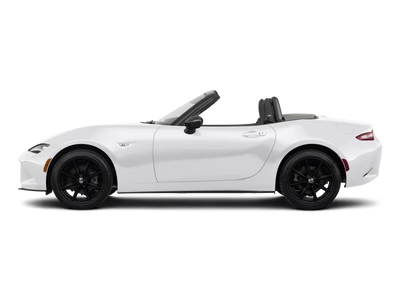

 Insights
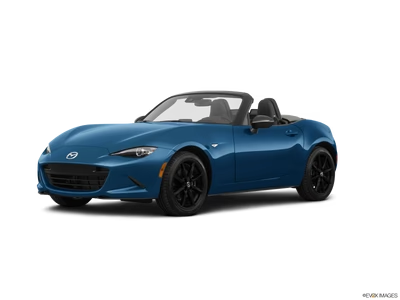
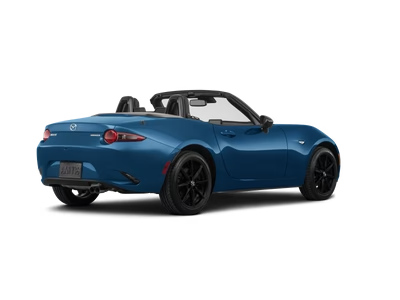
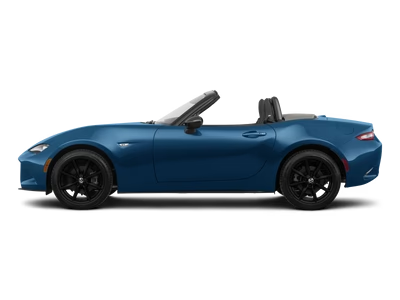
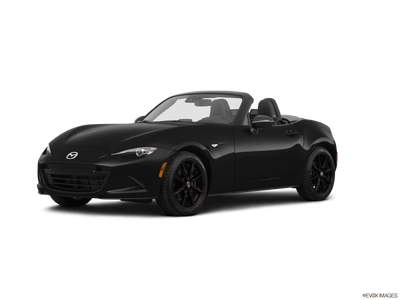
Mazda Miata Hands-On Test Drive
Driven by Carter MacLeod
Trim Tested: Miata Grand Touring 6MT
Price as Tested: $33,360 (including destination charge)
How It Drives & Handles
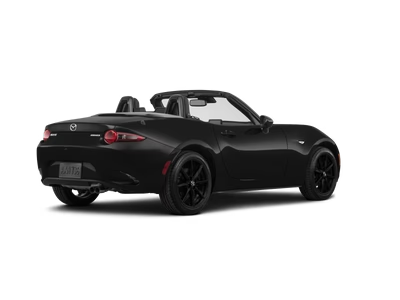
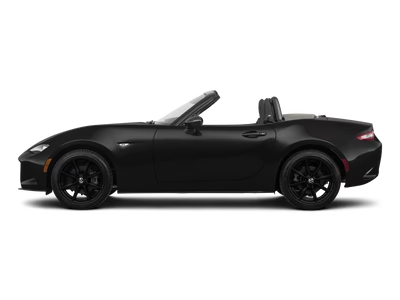
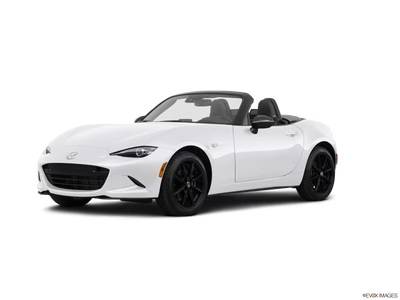
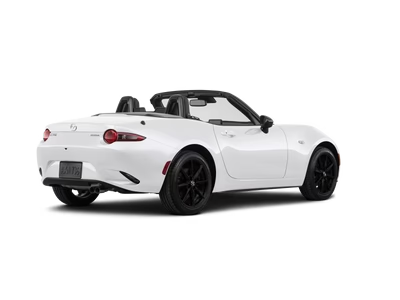
With a starting price of $26,830, Mazda’s iconic 2-seat convertible remains the best option on the market for inexpensive fun. It’s small and simple, focusing more on low cost and agility than power and tech.
I tested the Miata in the top-of-the-line Grand Touring trim with a manual transmission for a week. These are my impressions.
The Miata has one of the lowest horsepower ratings of any sports car on the market today, but thanks to its lightweight design, it still has lively acceleration.
I took the Miata to the mountains of West Virginia for the weekend, where its rear-wheel drive (RWD), tight steering, and sporty suspension helped it feel both lively and completely under control. The Miata sacrifices some ride comfort for the sake of sporty handling, but not much. The suspension is firm, but never jarring, even when hitting potholes.
My test car had the standard manual transmission, which is a joy to use. The shifter has short throws, meaning I could move through the gears quickly. And there are no fancy electronic gimmicks like the system in the Nissan 370Z that revs the engine when you downshift. It’s just your two feet and your right hand, working the throttle, brake, clutch, and gear shifter – a ballet of DIY sportiness.
As a bonus, the Miata gets tremendous fuel economy. I drove around the mountains all day and barely used a third of a tank of gas.
Comfort, Quality & Usability
The most important thing to know about the Miata before you purchase it, practically speaking, is: It’s small. There is enough room for 6-foot passengers like me; I actually had the seat pulled forward a notch or two. However, if someone much taller than 6’2” sat in the Miata, they’d have trouble fitting underneath the convertible top. The cabin is also narrow. Luckily, the Miata has the same simple, attractive interior styling that Mazda has in all of their vehicles.
The convertible soft top is one of the best in the business. It is solidly built, there’s a real glass rear window with a defroster, and the cabin is surprisingly quiet when the top is up. It’s not a powered retracting roof, but it’s so simple and quick to open or close – either takes about 5 seconds – that I’m glad it doesn’t have a motor (it would take longer to put up and down if it did). To lower it, the driver must pop a latch above the windshield’s center and pull back the roof. The hardest part of the process was locking it in place from the driver’s seat, which required me to push down hard, at an awkward angle.
To put the top up, drivers must pull a lever by their right shoulder, releasing the top, which pops up. Then they can pull it forward in one smooth motion. The only hiccup when putting the top up is that the windows aren’t one-touch up, so drivers have to hold the buttons to bring them back up. And if the windows are up before the top is, they’ll come back down when you secure the top, so drivers will have to raise them again.
The Miata’s trunk is tiny – barely big enough for a carry-on and a large purse – although it’s the same size with the top up or down, which is nice.
Storage in the cabin is almost nonexistent. There are no built-in cupholders, because the center console is too narrow. Instead, the Miata comes with two clip-on cupholders. There’s no glovebox, and the center console bin isn’t even big enough for a can of Coke (I was able to fit my house keys in there). The largest storage area is a little cubby in the area between the two seats. It has a locking door, and I could fit the owner’s manual in there, plus the cupholders when I wasn’t using them.
The Miata is all about simplicity, and that means limited features, even in the top-of-the-line Grand Touring trim I was driving. The benefit of that is lighter weight and a lower price, but it also means fewer creature comforts, such as power seats or adaptive cruise control. Sometimes this is a benefit. For instance, I prefer the simplicity of the manual parking brake to the electronic parking brake in most modern cars. Luckily, forward collision warning, automatic emergency braking, lane keep assist, and blind spot monitoring are all standard.
Like all Mazda products, the Miata uses the Mazda Connect infotainment interface. It combines a screen mounted high in the middle of the dashboard, a large knob on the center console, a few shortcut buttons, and a separate volume knob. The climate controls are located on a separate tier below the touch screen and consist of three large knobs. There’s no digital readout for the interior temperature setting, so I had to dial it based on the markings around the leftmost knob.
I think Mazda Connect is pretty easy to use, though some functions, like radio tuning, are buried in menus. The screen should also be a touchscreen – that would make it easy to make quick selections without having to use the knob. One highlight: the speakers that are built into the headrest, which helped calls come through clearly, even with the top down.
Editor’s Note: Review is based on test driving the 2021 model.
Carfax vehicle reviews let shoppers compare a vehicle’s specs against its competitors’. However, some aspects of a vehicle – performance, comfort, usability – can only be evaluated through actual driving. That’s why we evaluate as many vehicles as we can, so you’ll know what to expect.
© 2021 CARFAX. All rights reserved. This article may not be republished without written permission. To reprint or license this article, submit requests here.


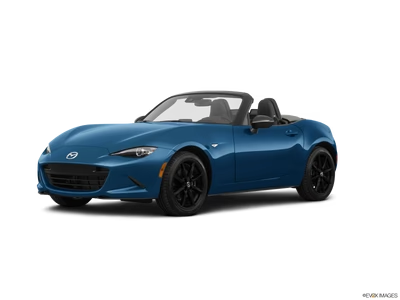

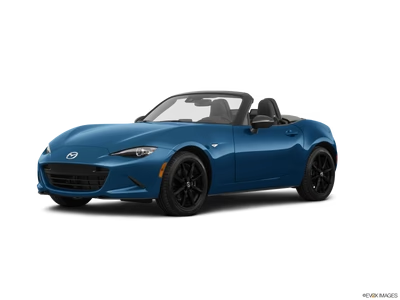

 No Accident or Damage Reported
 Personal Use
 CARFAX 1-Owner
 10 Service History Records
 2-Owner
 Accident/Minor Damage
 Minor Damage
 3+ Owners
 Rental Use
 Chevrolet Camaro
 Ford Mustang
 Nissan GT-R
 Volkswagen Golf

